
Exploring the Effectiveness and Implementation of Local Supplementary Feeding Programs for Undernourished Toddlers
DOI:
https://doi.org/10.69632/jgkk.v4i01.95Keywords:
Body Weight, Body Lenght, Intake, Local Supplementary Feeding (PMT), UndernutritionAbstract
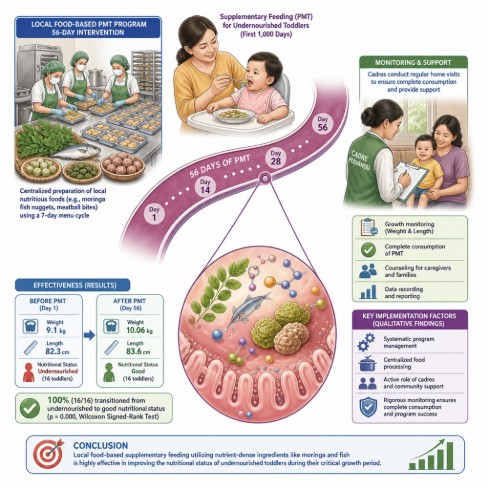
Background: Undernutrition among toddlers remains a critical public health challenge in Indonesia, significantly impacting cognitive and motor development during the first 1,000 days of life. This study aims to analyze the effectiveness of a 56-day local food-based Supplementary Feeding (PMT) program at the Bara-Baraya Community Health Center in Makassar City. Methods: This research employed a mixed-methods approach with a sequential explanatory design, involving 16 undernourished toddlers. The intervention consisted of a 56-day local food-based PMT, such as moringa fish nuggets and meatball bites, utilizing a 7-day menu cycle. Quantitative data were analyzed using the Wilcoxon Signed-Rank Test, while qualitative data were gathered through in-depth interviews with nutrition officers and cadres. Results: The study found a significant increase in anthropometric indicators, with average weight rising from 9.1 kg to 10.06 kg and average body length from 82.3 cm to 83.6 cm. Remarkably, 100% of the respondents (16 children) successfully transitioned from undernourished to good nutritional status (p=0.000). Qualitative findings indicated that the program's success was driven by systematic management, centralized food processing, and a rigorous monitoring strategy by cadres to ensure complete consumption. Conclusions: Local food-based PMT interventions utilizing nutrient-dense ingredients like Moringa and fish are highly effective in improving the nutritional status of toddlers during their critical growth period.
Downloads
Published
How to Cite
Issue
Section
License
Copyright (c) 2026 Mutiara Iriani Basri Fimbay, Hardyanti Subair, Marliah Marliah

This work is licensed under a Creative Commons Attribution-NonCommercial-ShareAlike 4.0 International License.